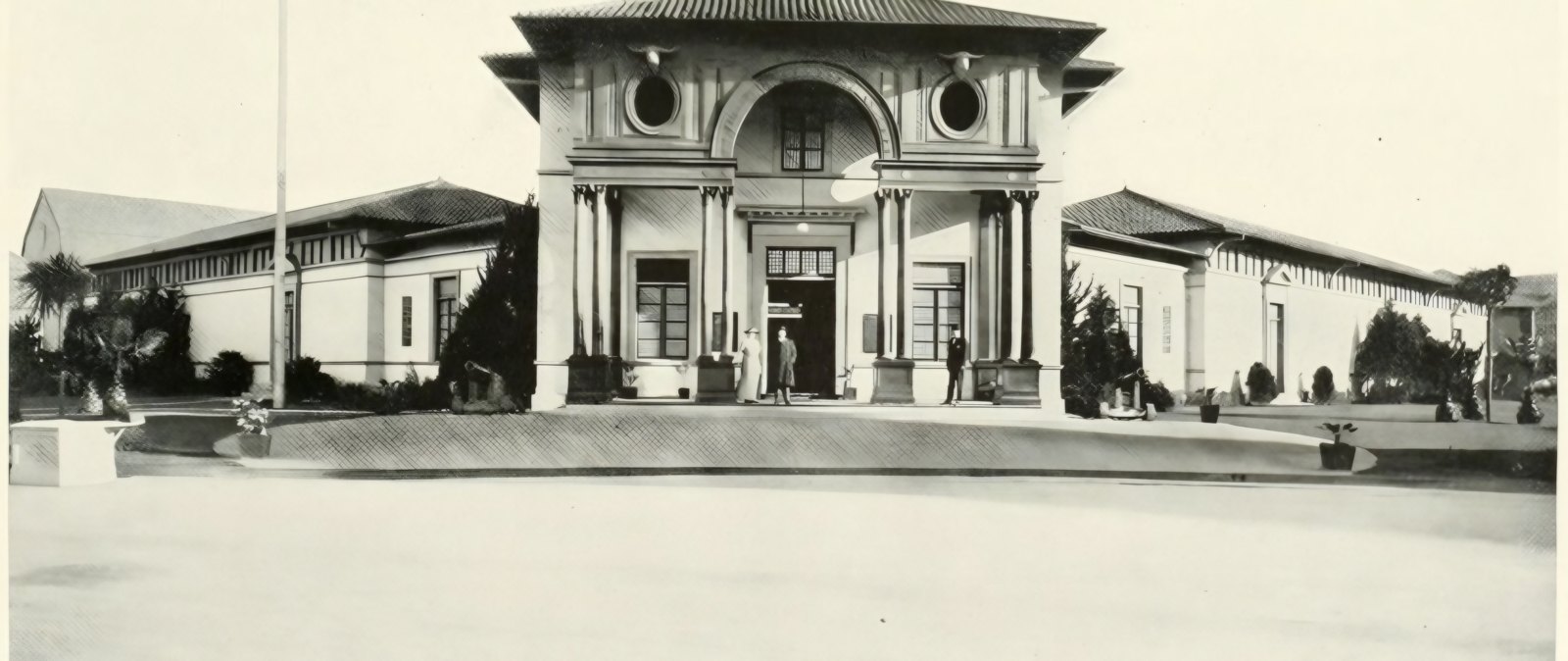
The Philippine Islands' building, designed by G. C. Fenhagen, consulting architect to the Philippine government, showed off island materials. It was mostly one story, with two over the administrative front. There were long flat walls with rows of windows of translucent capiz shell under broad eaves, a low red-tile roof, and a porch of sixteen natural palma-brava trunks. Two ancient brass cannon stood in front. Wings 40 feet wide and 248 feet long bent at right angles around a patio, where the Philippine Constabulary Band of 90 musicians played, and met at a conservatory of more than 2,000 orchids.
Visitors saw a hardwood reception hall and, to the left of the entrance, Filipino women weaving piña cloth. The Official Guide describes a left wing of native handicrafts with workers and a right wing of scientific, printing and public-works displays. The weavers worked in the sales department, on show beside the goods for sale. The islands had been an American possession since 1898, taken from Spain and held through the Philippine-American War, and the building showed them off under American rule. At its dedication on February 26, 1915, Dr. Leon Ma. Guerrero, president of the Philippine Board, told the crowd that the Filipinos hoped from America "their complete political emancipation."